Designing an Innovation Engine for a Global Organization
Business Design & Innovation Strategy
Fragmented technology operations were driving duplicated investments, rising costs, and competing priorities across a global organization. Through stakeholder research, strategic analysis, and rapid experimentation, I helped design an innovation operating model that balanced global strategy with regional autonomy and identified a pathway to $200M+ in technology cost savings.
This work is covered by an NDA; client details and proprietary materials have been anonymized while preserving the strategic approach, design process, and outcomes.

Client Name
Confidential Global Organization
Project Name
Designing an Innovation Engine for a Global Organization:
Technology Operations & Innovation Strategy
Role
Senior Consultant | Strategy & Business Design
Approach
Understand → Reframe → Design → Test → Activate
Goal
Identify opportunities to reduce costs, unlock value, and enable scalable innovation across global and regional teams.
Challenge
Decentralized technology operations created duplicated investments, fragmented governance, and competing priorities, limiting the organization’s ability to scale innovation and deliver against its five-year vision.
Scope
Technology Operations Assessment | Innovation Operating Model | Governance Design | Stakeholder Research & Alignment
Location
Global, cross-functional team across Chicago, New York, Seattle & Atlanta
Value Created
$200M+ cost savings opportunity | Innovation operating model | Governance framework | Implementation roadmap
Process

00 Challenge
How might we redesign technology operations and create a human-centered innovation model that balances global strategy with local autonomy—while reducing costs and enabling growth?
01 Discovery & Research
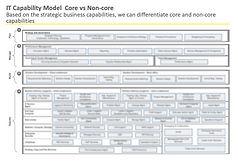
Fragmented ownership
Technology decisions were distributed without a shared mechanism for prioritization.
Underutilized investment
Existing capabilities weren't being fully leveraged before additional technology was introduced.
Global vs. local tension
Centralization created efficiency opportunities, but regional teams needed autonomy to respond to local needs.




02 Synthesize & Define
The opportunity wasn't simply to centralize technology. It was to design a model that could create enterprise scale without eliminating the flexibility regional teams needed to innovate.
Design Principles
-
Create a pathway to $200M+ in technology cost savings
-
Enable innovation to scale across regions
-
Balance global alignment with local autonomy
-
Establish shared governance for innovation and investment
-
Unlock greater value from existing technology investments
03 Ideate
Strategic Concepts Explored
Innovation operating model — centralized coordination with flexible regional participation.
Automation pilots — test RPA against high-friction workflows before scaling.
Cloud-first strategy — establish decision principles for future technology investments.
Collaboration platform — create visibility across regional innovation efforts and reduce duplication.


04 Prototype & Test
Prototyped governance structures, collaborative tools, and pilot initiatives to test how the innovation model could operate in practice.
Workshops and pilot feedback reinforced the need for centralized coordination with flexible regional participation, informing refinements to governance, ownership, and the implementation roadmap.
05 Activate
-
Delivered an implementation roadmap identifying a pathway to $200M+ in technology cost savings while maintaining service quality and enabling growth.
-
Launched the innovation operating model, establishing governance and collaborative infrastructure to connect global strategy with regional innovation.

Outcome
$200M+ VALUE PATHWAY
Developed a roadmap targeting $200M+ in technology cost savings while maintaining service quality.
TEST-AND-LEARN CAPABILITY
Introduced pilots and prototyping to evaluate automation and technology opportunities before broader investment.
INNOVATION OPERATING MODEL
Designed a scalable model connecting global strategy, regional autonomy, governance, and experimentation.
PATH TO ACTIVATION
Translated research and strategic analysis into governance, investment principles, and an actionable implementation roadmap.