Turning an Underused Enterprise Platform into a User-Centered Growth Tool
Human-Centered Innovation | Research → Personas → Pilot → Scale
Salesforce had been implemented around technology requirements rather than user needs, resulting in low engagement, limited adoption, and no shared vision for its role in the business.

Client Name
Health Care Service Corporation (HCSC) A.K.A. Blue Cross Blue Shield of IL, MT, OK, TX, NM
Project Name
Salesforce Transformation / Salesforce Lightning Migration
Role
Project Lead and Strategic Designer
Approach
80–100 interviews → personas → concepts → representative pilot → iteration → scaled implementation
Challenge
An enterprise platform designed around technology—not the people expected to use it.
Salesforce Classic had been implemented by the technology group without input from the Sales function or a long-term vision, resulting in low engagement, poor adoption, and limited effectiveness of the tool.
Scope
Human-Centered Research
Experience Strategy
Persona Development
Pilot Design
Product Adoption
Organizational Enablement
Location
Chicago, IL
Impact
150% increase in engagement | On-demand, in-app learning | Five-year product vision
Process

00 Challenge
How might we redesign Salesforce around user needs to increase engagement, improve adoption, and establish the platform as a trusted single source of truth?
01 Discovery & Research
Existing Experience:
-
Salesforce Classic had been in use for 5+ years without strategic planning.
-
Major issues included low engagement, lack of training, and no alignment with sales needs.
Stakeholder Interviews:
-
Conducted 80-100 interviews to understand role-specific needs and challenges.
Key Insights
-
User needs weren't driving requirements. Platform decisions had been made without sufficient validation from end users.
-
One experience couldn't serve every role. Distinct user groups had different workflows, needs, and definitions of value.
-
Adoption was an experience problem—not simply a training problem. The platform, communication, workflows, and perceived value of Salesforce were disconnected from how users actually worked.


02 Synthesize & Define
Personas Development:
Synthesized research into role-based personas that revealed distinct workflows, needs, barriers, and definitions of value—shifting the strategy from a one-size-fits-all implementation toward differentiated product experiences.
Problem Statement:
Salesforce adoption was constrained by a disconnect between platform requirements, user workflows, communication, and perceived value.
03 Ideate
Design Principles
-
Role-Based Experiences: Tailored guidance, workflows, and resources around the needs of distinct user groups.
-
Embedded Digital Enablement: In-platform guidance designed to reduce friction and support users at the moment of need.
-
Participatory Adoption Model: Workshops, feedback loops, and super users that enabled the experience to evolve alongside users.
-
Long-Term Product Vision: A strategic roadmap positioning Salesforce as a trusted single source of truth rather than simply another enterprise tool.
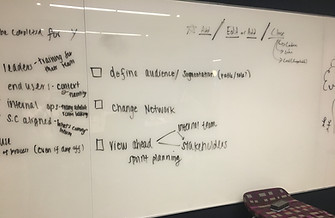


04 Prototype
Representative Pilot
Built a pilot group spanning all user personas to test role-specific experiences and validate assumptions before broader rollout.
Facilitated use-case workshops and feedback sessions to identify friction, refine solutions, and inform the scaled implementation strategy.
Digital Adoption Prototype
Configured WalkMe to provide real-time, in-app guidance, streamline onboarding, and address common user questions at the point of need.
05 Scale & Iterate
Scale
Rolled out role-based experiences tailored to distinct user needs.
Learn
Embedded continuous feedback mechanisms through WalkMe and stakeholder workshops.
Sustain
Established a representative Super User Network to surface friction and continuously evolve the Salesforce experience.

Impact
User Adoption
Continuous Enablement
Increased Salesforce engagement by 150% through role-based, user-centered experiences.
Shifted from quarterly training sessions to embedded, real-time learning and feedback, creating a scalable and self-service adoption experience.
Product Strategy
Scalable Experience
Established a five-year roadmap positioning Salesforce as a strategic business platform.
Designed a repeatable adoption model grounded in personas, pilots, and iterative learning.
Continuous Evolution
Created governance mechanisms that enabled ongoing feedback, refinement, and long-term adoption.
Reflection
This project fundamentally changed how I think about technology adoption.I learned that successful implementation isn't driven by better training—it begins by understanding the people the technology is meant to serve. By reframing Salesforce as an experience design challenge rather than a technology rollout, we created a solution that users embraced because it reflected how they actually worked.